Free Ebook Build Your Own Low-Power Transmitters: Projects for the Electronics Experimenter, by Rudolf F. Graf
Follow up just what we will offer in this short article concerning Build Your Own Low-Power Transmitters: Projects For The Electronics Experimenter, By Rudolf F. Graf You recognize truly that this publication is coming as the very best vendor book today. So, when you are really an excellent visitor or you're fans of the writer, it does will be funny if you don't have this book. It suggests that you need to get this book. For you that are beginning to learn about something new and feel interested regarding this book, it's very easy after that. Simply get this publication and really feel how this publication will certainly give you a lot more exciting lessons.
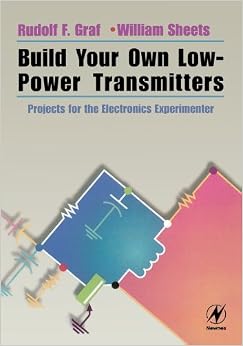
Build Your Own Low-Power Transmitters: Projects for the Electronics Experimenter, by Rudolf F. Graf

Free Ebook Build Your Own Low-Power Transmitters: Projects for the Electronics Experimenter, by Rudolf F. Graf
Build Your Own Low-Power Transmitters: Projects For The Electronics Experimenter, By Rudolf F. Graf. Join with us to be member here. This is the website that will provide you ease of browsing book Build Your Own Low-Power Transmitters: Projects For The Electronics Experimenter, By Rudolf F. Graf to read. This is not as the other site; the books will certainly remain in the types of soft documents. What benefits of you to be member of this site? Get hundred collections of book connect to download and install and also get constantly upgraded book every day. As one of the books we will certainly provide to you currently is the Build Your Own Low-Power Transmitters: Projects For The Electronics Experimenter, By Rudolf F. Graf that comes with a very satisfied principle.
Many individuals checking out a publication as they require it at the time, exactly they require some parts of web page to offer the inspirations. Or even, simply few page from guide that always provide referral for your works or tasks. This is why many readers are the autodidact readers. Possibly, a few of the visitors of Build Your Own Low-Power Transmitters: Projects For The Electronics Experimenter, By Rudolf F. Graf are additionally as well. However, it does not indicate that there is none that love analysis book since it is their habit. There are additionally several of people that constantly do finishing checking out guide as their necessity. As their habit as well as society, analysis will assist them well.
You may not feel that this publication will be as crucial as you assume today, however are you certain? Discover more concerning Build Your Own Low-Power Transmitters: Projects For The Electronics Experimenter, By Rudolf F. Graf as well as you could actually discover the benefits of reading this book. The provided soft file publication of this title will certainly offer the outstanding scenario. Even analysis is just leisure activity; you can begin to be success b this publication. Believe extra in judging the books. You might not judge that it is necessary or not currently. Read this publication in soft data and obtain the ways of you to save it.
Caring this book indicates loving your leisure activity. Reading this publication will certainly indicate leading life high quality to be far better. Much better in al thing may not be attained in other words time. But, this book will aid you to always enhance the kindness and spirit of much better life. When locating the Build Your Own Low-Power Transmitters: Projects For The Electronics Experimenter, By Rudolf F. Graf to download, you may not disregard this. You have to get it now and read it quicker. Sooner you read this publication, sooner you will be a lot more success from previous! This is your choice as well as we constantly think about it!
Rudolf Graf and William Sheets have written a book containing twenty low-power (LP) transmitter projects, perfect for the electronics hobbyist and radio experimenter. Now that the FCC has changed its regulations about "pirate" transmissions, more and more people are setting up radio and video stations for broadcast from their homes. Build Your Own Low-Power Transmitters addresses applications for hobbyist broadcasting of AM, SSB, TV, FM Stereo and NBFM VHF-UHF signals with equipment the reader can build himself for thousands of dollars less than similar equipment sold on the retail market. The authors also fully explore the legal limits and ramifications of using the equipment as well as how to get the best performance for optimum range. The key advantage is referencing a low-cost source for all needed parts, including the printed circuit board, as well as the kit. Projects in the book include: LP FM stereo transmitter; digitally synthesized PLL FM stereo transmitter; LP AM transmitter for 150-1710 KHz; radio control transmitter/receiver; carrier current transmitter and AM and FM receivers; LP VHF one-way and two-way audio links; 1-watt 40-meter CW transmitter for ham radio use; SSB LP transmitter for 10-meter ham radio use; 2-meter VHF FM ham radio transmitter; FM video link for 900 MHz NTSC/PAL operation; 2-watt TV transmitters for 440, 900 and 1300 MHz amateur TV NTSC/PAL transmissions; linear amplifier for 440MHz, 10-15watt NTSC/PAL operation; Downconverters for 440, 900 and 1300 MHz with VHF channel 3 or 4 output; TV video receiving systems and AM-FM IF systems; LP video link for UHF channels 14-18; 1-watt CW beacon transmitter for Part 15 LF radio experimentation; CW identifier for transmitters; test equipment projects for LP transmitters; as well as an RF power meter and modulation monitor. Complete source information will be included to help each reader find the kits and parts they need to build these fascinating projects.Unique among comparable project books, this one offers a low-cost source for all parts, including the printed circuit board. This allows immediate completion without needing to search for difficult to find partsFeatures twenty low-power transmitter projects
Your recently viewed items and featured recommendations
›
View or edit your browsing history
After viewing product detail pages, look here to find an easy way to navigate back to pages you are interested in.
Product details
Paperback: 291 pages
Publisher: Newnes; 1 edition (August 3, 2001)
Language: English
ISBN-10: 0750672447
ISBN-13: 978-0750672443
Product Dimensions:
7 x 0.7 x 10 inches
Shipping Weight: 1.1 pounds (View shipping rates and policies)
Average Customer Review:
3.7 out of 5 stars
9 customer reviews
Amazon Best Sellers Rank:
#1,968,733 in Books (See Top 100 in Books)
may be an old book, but I built 2 of the projects, and they worked first time.hard to find old parts, but you can still do it.made my own PCB's and couldn't be more satisfied.
thank you
The book was not what I was looking for. I was looking for a book to help me design and duild a simple low power transmitter. The book had a realy good section on Oscillators circuets and what type of oscillator works best for what type of application. Other then that, the rest of the book was pre-cand Low Power Tranmitters circuet designs, to build. Don't take this as bad. It just did not work for me. The transmitter circuet designs look good, just did not fit my aplication.The book was well ritten and easy to read.If you are looking to design and build a simple low power AM transmitter, I have found "Basic Radio: Understanding the Key Building Blocks" is a good place to start.
This is a very disappointing book. The preface promises "All projects use standard parts and have been thoroughly tested, with PC board layouts given for most the projects, as well as parts lists, coil data, and complete setup information." However, the only time it delivers all this information is when the transmitter in question is a kit from a certain vendor in New York State. For everything else, the information supplied is minimal at best.For instance, Chapter 16 (Low-Power Narrowband FM Transmitters) provides a schematic for a ¼ watt amateur 2 meter FM transmitter that completely omits data on all coils, inductors, etc. in the design. There's no parts list, no PC board layout, and minimal description of the circuit. The chapter goes on to describe a UHF transmitter based on an obsolete integrated circuit.Now I can't fault the authors for including a design based on an obsolete chip. The chip was probably in full production when this chapter was written. However, omitting the coil data for the 2 meter transmitter is unacceptable.Chapters describing the various transmitter kits are chock full of information. There's also some interesting chapters on FM stereo generation and serial data remote control. However, on a whole, the book leaves out a lot of detail on the transmitters I bought it for. I would have been better off looking for a suitable ARRL publication.
You will be interested in this book if you:o Want to know how to build low-power AM and FM broadcast transmitters of a professional standard;o Want to know how to build low-power TV transmitters for VHF and UHF;o Want to learn some advanced techniques;o Have experience in radio transmitter construction;o Have experience with surface mount devices (SMD);o Understand schematics;o Know how to etch PCBs from a published layout.This book is not suitable for:o Beginners;o Those with little experience in electronics construction and design.This is the book you have been looking for if you want to build a good quality but low power broadcast transmitter for a community radio station, or an isolated settlement like a cattle station homestead, mining camp or outstation. Initially I thought that it would suit pirate radio operators but even a cursory glance at eBay tells me that these people are well catered for by respectable Chinese businessmen.Like many such books, the first two chapters cover elementary theory but if you find them difficult the rest of the book will be impossible. The first circuits displayed are "wireless microphones" and a phone line bug and some other small beginners circuits, then a simple but well-designed 50mW AM transmitter before introducing an AM transmitter for long wave, medium wave and the extended 1700kHz band based on the MC145151-2 phase locked loop.FM broadcasting circuits start with a simple VFO tuned mono transmitter then after a discussion of multiplexing on to another MC145151-2 based transmitter for stereo transmissions from 76 to 108 MHz, followed by a microprocessor controlled transmitter.Next are presented a low power VHF and two UHF TV transmitters, then a microprocessor based remote control system. There are circuits for 2 metres FM and 40 metres CW with a field strength meter and a sideband generator for 11MHz and a 1750kHz transmitter.Writing is clear and there are many detailed diagrams provided as well as PCB layouts suitable for copying. If carefully constructed these circuits should provide many years of use.
Great book! It is the backbone of transmitting and receiving. If you want to learn how to build or how transmitters and receivers work get this book!! The only thing I don't like is the designs are not that up to date, but you need to know them to build better transmitters / receivers. This is a great book for getting into RF. The best part is you can build everything!!
The projects in this book are very hard to complete. Don't buy it unless you are really familiar with advanced electronics.
Thanks
Build Your Own Low-Power Transmitters: Projects for the Electronics Experimenter, by Rudolf F. Graf PDF
Build Your Own Low-Power Transmitters: Projects for the Electronics Experimenter, by Rudolf F. Graf EPub
Build Your Own Low-Power Transmitters: Projects for the Electronics Experimenter, by Rudolf F. Graf Doc
Build Your Own Low-Power Transmitters: Projects for the Electronics Experimenter, by Rudolf F. Graf iBooks
Build Your Own Low-Power Transmitters: Projects for the Electronics Experimenter, by Rudolf F. Graf rtf
Build Your Own Low-Power Transmitters: Projects for the Electronics Experimenter, by Rudolf F. Graf Mobipocket
Build Your Own Low-Power Transmitters: Projects for the Electronics Experimenter, by Rudolf F. Graf Kindle