Free PDF The Geography of Genius: Lessons from the World's Most Creative Places, by Eric Weiner
Now readily available! The Geography Of Genius: Lessons From The World's Most Creative Places, By Eric Weiner as the most desired book on the planet. Guide that is for grownups as well as teenagers are coming. You may have been awaiting this publication for long moments. So, this is the right time to get it. Never ever play with the time anymore, when you have the opportunity to gain this publication, why should play with it? When browsing the title of this book here, you will straight see this page. It will situate you to make far better choice of reviewing book.
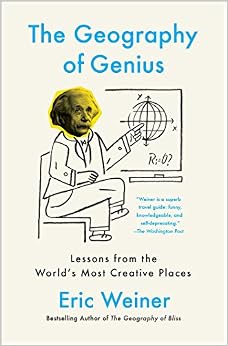
The Geography of Genius: Lessons from the World's Most Creative Places, by Eric Weiner

Free PDF The Geography of Genius: Lessons from the World's Most Creative Places, by Eric Weiner
After few time, finally guide that we as well as you await is coming. So alleviated to obtain this fantastic book available to provide in this internet site. This is the book, the DDD. If you still feel so tough to obtain the printed book in the book shop, you can join with us again. If you have actually ever obtained the book in soft file from this book, you can conveniently get it as the recommendation currently.
Why should be this publication? This is just how guide will certainly be referred. It is really used to get rid of the knowledge as well as inspirations from guide. During this time, it remains in the checklist of excellent books that you will certainly locate in this world. Not just individuals from that nation, numerous international people additionally see as well as obtain the depictive information and also ideas. The Geography Of Genius: Lessons From The World's Most Creative Places, By Eric Weiner is what we have to try to find after obtaining the kinds of guide to need.
As well as why should read this publication? Many know that in this period, some books are covered in hefty points to load. A few other will be likewise complemented in language trouble to understand. The Geography Of Genius: Lessons From The World's Most Creative Places, By Eric Weiner is among the most up to date released books that has straightforward principle of assumed with remarkable facts as well as lessons. It will certainly educate you couple of things simple with simple language to understand. Even you are from the foreigners, this publication is also simple enough to be translated.
Lots of people who succeed and also wise have great analysis routine. Even their analysis products are various. When you are diligent sufficient to do reading on a daily basis, also couple of mins in your extra time, your success and also prestige will certainly establish. The people that are taking a look at you may be appreciated regarding just what you do. It will offer little bit self-confidence to improve. So, when you have no suggestion concerning exactly what to do in your spare time currently, allow's examine to the link to get the The Geography Of Genius: Lessons From The World's Most Creative Places, By Eric Weiner as well as read it faster.
Tag along on this New York Times bestselling “witty, entertaining romp” (The New York Times Book Review) as Eric Winer travels the world, from Athens to Silicon Valley—and back through history, too—to show how creative genius flourishes in specific places at specific times.In this “intellectual odyssey, traveler’s diary, and comic novel all rolled into one” (Daniel Gilbert, author of Stumbling on Happiness), acclaimed travel writer Weiner sets out to examine the connection between our surroundings and our most innovative ideas. A “superb travel guide: funny, knowledgeable, and self-deprecating” (The Washington Post), he explores the history of places like Vienna of 1900, Renaissance Florence, ancient Athens, Song Dynasty Hangzhou, and Silicon Valley to show how certain urban settings are conducive to ingenuity. With his trademark insightful humor, this “big-hearted humanist” (The Wall Street Journal) walks the same paths as the geniuses who flourished in these settings to see if the spirit of what inspired figures like Socrates, Michelangelo, and Leonardo remains. In these places, Weiner asks, “What was in the air, and can we bottle it?” “Fun and thought provoking” (Miami Herald), The Geography of Genius reevaluates the importance of culture in nurturing creativity and “offers a practical map for how we can all become a bit more inventive” (Adam Grant, author of Originals).
Your recently viewed items and featured recommendations
›
View or edit your browsing history
After viewing product detail pages, look here to find an easy way to navigate back to pages you are interested in.
Product details
Paperback: 368 pages
Publisher: Simon & Schuster; Reprint edition (November 1, 2016)
Language: English
ISBN-10: 145169167X
ISBN-13: 978-1451691672
Product Dimensions:
5.5 x 0.8 x 8.4 inches
Shipping Weight: 10.4 ounces (View shipping rates and policies)
Average Customer Review:
4.2 out of 5 stars
221 customer reviews
Amazon Best Sellers Rank:
#306,961 in Books (See Top 100 in Books)
First of all, this book does strike one as being a bit of a travelogue, rather than the historic analysis that the title presumes it to be, but I hung on through the opening chapters and began to find more correlations and soft conclusions as the observations and comparisons mounted. Plus, I basically agree with Weiner’s contention that (a society) gets the geniuses that it demands and deserves. To someone who hasn’t read the book that may sound like a flimsy statement, but I feel it holds a core truth worthy of deeper appreciation and application.This book could be of tremendous importance to anyone working to develop a community culture in the arts, sciences, technology, ecology, vinology, industry, etc.
This book should not be allowed to have this title. The title is way too cool, promising a true study of why some communities/civilization breed so much innovation. Instead this was a light travel book, touching on the state of certain cities at certain times without any in depth analysis or research. If you like cheesy humor and easy to read commentary that is not backed up by study you will probably not be as annoyed as I was by this book.
There's a school of thought that runs something like this: the average US citizen isn't very bright, has a limited attention span, and has an appetite only for the superficial. So if you want to write a book about something you feel to be important, you have to sugar the pill - with lots and lots of sugar and make sure it's a very small pill indeed.Hence the style "American-Folksy." In this genre the author leads the reader gently along by means of first-person narrative, tons of anecdote, and just the gentlest hint of new information here and there. The lexicon is undemanding and the pace is calculated to be just brisk enough to prevent the onset of catatonia while being leisurely enough not to require any strenuous intellectual activity on the part of the reader. It's basically DisneyWords.This is a well-tried genre used across a wide variety of subjects. In Search of Excellence and The Omnivore's Dilemma both use the same style despite their contexts being very different. And Weiner uses American-Folksy here for precisely the same reasons and to precisely the same effect. The purpose of American-Folksy is to take something that could have made a somewhat interesting 6-page monograph and stretch it out into a book-length peregrination.The problem with American-Folksy, however is that it's not just a question of stretching things out and diluting ideas into easy-to-digest micro-fragments. The core problem is that when you meander around a topic rather than condense it down to its essentials you can very easily overlook the logical flaws inherent in your treatment and the gaps in your arguments. And that's precisely the problem with this book. It tries to identify a particular set of conditions that may give rise to an unusual density of "geniuses" at a particular moment in time. In other words, it tries to use the same concept as Jared Diamond's seminal Guns Germs and Steel: what's the "secret sauce" that results in a particular outcome?Unfortunately "genius" is a slippery concept. Weiner is never quite sure whether he means creativity or something else. He's also uncertain about whether "genius" is objective or subjective. And when it comes to the accretion of "helpful facts and ideas" he ranges so widely that his central thesis appears to collapse into nothing more than an assortment of anecdotes. He cites studies that purport to prove what the experimenters were hoping to find (which, we know, are usually not worth the paper they are written on) and in which the "findings" are wonderfully undefined: as in "the test subjects were more creative." How was this "creativity" measured? Was it a properly designed double-blind study? Well, we do at least have a proper bibliography so if we're sufficiently interested we can review the research ourselves but it's difficult to have much confidence in what's presented.This is not mere nit-picking. The objection is at the heart of empiricism. If you can't define it you can't measure it, and if you can't measure it you can't make meaningful statements about it. Most people are content with vague notions that blur at the edges because they rarely stop to think about what they truly are attempting to convey. We habitually use language with tremendous imprecision, so that "I'm starving" actually means "I've never actually been truly hungry in my life but I haven't eaten for ninety minutes and I always eat a cheeseburger and fries around this time of day." For quotidian discourse this kind of lazy speech is acceptable (after all, who in the USA has every been truly hungry?) but it's not acceptable in a book purporting to investigate a serious phenomenon and draw conclusions about it. Nor is the assumption that correlation is causation. For every "contributory factor" Weiner purports to identify it's easy to think of several instances in which genius did not emerge. In Search Of Excellence suffered from precisely the same problem: cherry pick a few outcomes, work backwards to identify common features, and voila: you have the desired recipe. Except that there are lots of other examples where the same recipe doesn't produce the same outcome. Every newbie statistician learns this lesson; it's a shame that this wasn't among the many anecdotes Weiner picked up in the course of his peripatesis.Another problem comes from the fact that for all the name-dropping, Weiner doesn't actually know very much about the subjects he ranges across. When discussing Einstein, for example, he makes the legitimate point that had the great man been born in another era he wouldn't have developed his Special Theory of Relativity. But Weiner seems to think this would have been because (a) there wouldn't have been the physicists around to appreciate it, and (b) the young Einstein would have chosen a different contemporary field of study where there were more obvious opportunities. What Weiner doesn't note, however (doubtless because he doesn't know much about physics) is that without the prior contributions of Maxwell and Lorentz the Special Theory could not have been developed, just as without Lyell it is unlikely that Darwin would have been able to develop his theory of Evolution. These (and several other examples) demonstrate that it is highly unwise to write a book speculating about the "causes" of genius when you don't have a grasp of the fundamentals. It's easy to be superficial; quite another matter really to get to grips with the material. Weiner, like so many people of our age, is content to confuse surface with depth.The final flaw in Weiner's somewhat sketchy thesis comes in the last chapter when he breathlessly alights in Silicon Valley. Whereas the "genius" examples Weiner selected from the vast skein of history contributed new ideas and new perspectives to humanity, Weiner's Valley examples contribute merely utility. Utility is a good thing, but if the provision of utility were a qualifier for the epithet "genius" then surely Weiner should have heaped upon our plate in earlier chapters examples from the Industrial Revolution? Surely the development of the railway, the development of steel cutlery, the development of internal plumbing and central heating and powered elevators and suchlike should have been included in his round-the-world-in-eighty-anecdotes book? Weiner seems to accept that the utility of a smartphone or a social media website is akin to the intellectual breakthroughs he has charted earlier. Yet a moment's reflection shows this to be nonsense. I may personally value toilet paper more than I value the works of Jacques Derrida but that doesn't make the guy who invented the machine to make toilet paper a "genius." This is particularly germane because today's Silicon Valley is largely caught up in trivia. Few are working on the complex underpinnings of our information age. The great leaps forward (in processor and memory devices, in data storage, in data transmission and networking) have been taken for granted and now the focus is on superficial objectives such as creating apps that enable people to select the right wine pairing with their choice of main course. While perhaps marginally useful they are not game-changing. Facebook and Twitter may be used by people occasionally for more than just posting pictures of cats but in essence they are merely outlets for virtual graffiti. And in contrast to other locations cited earlier in the book (the central thesis of which is that at a particular moment in time a particular place becomes the incubator for many different forms of genius) Silicon Valley has spawned no cultural efflorescence. For all the thousands of geeks tapping away at keyboards trying to invent the Next Big App there has been no outpouring of art. These young wannabes are content to listen to stale formulaic pop, read each other's Tweets, and the closest to high culture they ever reach is Friday night standup improv. At least Manchester's dark satanic mills inspired Blake.By failing to grasp the difference between the useful and the revolutionary, and by signally failing ever to define (even vaguely) what he might mean by "genius" Weiner ultimately reveals that the cards he's been attempting to play are nothing more than a random assortment. It's the ultimate in bathos.Perhaps if Weiner had attempted to distill his thesis into a handful of pages he'd have been forced to see its intellectual inadequacies and then, perhaps, he might have been motivated to address them. The result would have been an interesting thesis. As it is, The Geography of Genius reads rather as if someone had given a precocious High School student a year-long travel grant. It's an interesting vacation report but little more. If you are looking for an "airport book" but don't care for the tedium of thrillers-by-numbers or the latest ghost-written tell-all of some ephemeral celebrity, this book will offer a little more substance to while away a few hours. But it could, in principle at least, have offered a great deal more.
Travelling through time and space, with the aid of some knowledgeable guides, Eric Weiner takes the reader on a tour of humanity’s hot spots over the last two and a half millennia. He begins with Athens in the Golden age and ends with, what else, Palo Alto in the Silicon age. Interspersed with lively metaphors and well-suited aphorisms, it reads without interruption and organizes a number of thoughtful studies on the topics of what cultivates creativity. This reviewer takes a bit of an exception to the fixation on Freud, who admittedly was a creator of new and surprising ideas, but ones that may have been found wanting in terms of validation. Otherwise, the places, including Vienna in 1900, and people, and the connections among them provide insights worth having and questions worth asking.Diverse, disorderly, and discerning, to quote the author, his tour entertains, informs, and invariably engages the reader, even if there are some not necessarily inappropriate ups and downs in the ebb and flow in the journey. For anyone interested in cultivating young creators or in developing environments that promote adult creativity, which includes almost all parents, teachers and entrepreneurs, this book offers something different and worthwhile. The fast food consumers of business books should be forewarned, however, this is not a book filled with bullet point answers to satisfy one’s curiosity, but rather, a multi-course meal with a variety of offerings meant to enrich one’s appreciation of a subject that is tantalizing, relevant, and complex.
A fascinating read about how Places and circumstances create an environment that allows and encourages genius to thrive. As a former teacher, I am aware of how well intended programs and theories of education thwart creative thinking and how gifted intelligence does not necessarily create success stories. Thinking out side the box or even better beyond the box must be encouraged. There is no better feeling than having a student take an assignment and run with it or see a student use a lesson as a launching board to other ideas. I worry that today’s emphasis on testing outcomes is creating generations of great memorizes who know many facts but little substance. All educators and parents who seek to instill problem solving and creative thinking should read this book. Yes, I think it is that important. We need to be the flame that sets our childrens’ genius on fire.
Excellent and engaging. I read this with my 5th grade daughters and we all learned a lot more about geography than I anticipated. The style is engaging, and the girls were eager to tell their dad interesting tidbits and to show him interesting places on the map. Great for an introduction, overview, and compilation of trivia about geography.
The Geography of Genius: Lessons from the World's Most Creative Places, by Eric Weiner PDF
The Geography of Genius: Lessons from the World's Most Creative Places, by Eric Weiner EPub
The Geography of Genius: Lessons from the World's Most Creative Places, by Eric Weiner Doc
The Geography of Genius: Lessons from the World's Most Creative Places, by Eric Weiner iBooks
The Geography of Genius: Lessons from the World's Most Creative Places, by Eric Weiner rtf
The Geography of Genius: Lessons from the World's Most Creative Places, by Eric Weiner Mobipocket
The Geography of Genius: Lessons from the World's Most Creative Places, by Eric Weiner Kindle