Ebook Download Thinking Through the Past, Volume I By John Hollitz
When you need a publication to check out now, Thinking Through The Past, Volume I By John Hollitz can be a selection since this is just one of the updated publications to check out. It is sure that when you have new thing to think about, you require ideas to resolve t. and when you have time to check out, guides become one service to take. Also this book is thought about as new publication, lots of people place their trusts on it. It will certainly understand you to be one of them that are falling in love to review.
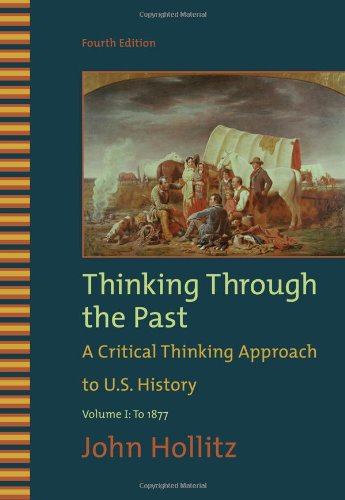
Thinking Through the Past, Volume I By John Hollitz

Ebook Download Thinking Through the Past, Volume I By John Hollitz
Exactly what's your task currently? Is this your leisure? Just chatting in your YM? Ohm, we assume that you need new task currently. Exactly what about reviewing publication? It's uninteresting? Not at all, actually there is a really fascinating publication that could aid you to make use of the time effectively. Thinking Through The Past, Volume I By John Hollitz is the title of guide. This book is not a challenging book. Certainly, it is really appropriate for you in this time, the fun book as well as delight topic to read.
Well, exactly what concerning you who never ever read this sort of book? This is your time to begin knowing and also reading this kind of book genre. Never ever doubt of the Thinking Through The Past, Volume I By John Hollitz that we provide. It will certainly bring you to the truly new life. Also it does not indicate to the genuine brand-new life, we make certain that your life will certainly be better. You will certainly likewise find the brand-new points that you never ever obtain from the other sources.
We have hundreds listings of the book titles that can be your guidance in locating the ideal book. Searching by the title will make you less complicated to get what publication that you really desire. Yeah, it's because so many publications are supplied in this website. We will reveal you how sort of Thinking Through The Past, Volume I By John Hollitz is resented. You might have searched for this book in numerous areas. Have you discovered it? It's much better for you to seek this book as well as other collections by here. It will certainly reduce you to discover.
Really, this is not a force for you to like this publication and also check out till surface this publication. We reveal you the excellent book. It will be so pity if you miss it. This is not the correct time for you to miss the Thinking Through The Past, Volume I By John Hollitz not to check out. It could aid you not only fulfilling this vacation times. After vacations, you will certainly obtain something new. Yeah, this book will really lead you to life much better. This is why; this recommended publication is much uttered for you that want to move on constantly.
- Sales Rank: #76468 in Books
- Published on: 2009-06-08
- Original language: English
- Number of items: 1
- Dimensions: .53" h x 6.41" w x 9.12" l, .99 pounds
- Binding: Paperback
- 352 pages
Review
Each chapter begins with Setting and Investigation sections and ends with Conclusion, Further Reading, and Notes. 1. THE TRUTH ABOUT TEXTBOOKS: INDIANS AND THE SETTLEMENT OF AMERICA. Sources: History of the American People (1927). The American Pageant (1966). A People & A Nation (2008). 2. THE PRIMARY MATERIALS OF HISTORY: CHILDHOOD IN PURITAN NEW ENGLAND. Sources: Elizabeth Eggington (1664). Henry Gibbs (1670). Letter of Samuel Mather (Age 12) to His Father (ca. 1638). Massachusetts Court Records. Lawrence Hammond, Diary Entry for April 23, 1688. Cotton Mather on Young Children (1690). An Arrow against Profane and Promiscuous Dancing (1690). Samuel Sewall on the Trials of His Fifteen-Year-Old Daughter (1696). The Well-Ordered Family (1719). The Duty of Children toward Their Parents (1727). A Puritan Primer warns Against Frivolous Behavior (?). The Roger Mowry House (ca. 1653). The Eleazer Arnold House (ca. 1864). 3. EVALUATING PRIMARY SOURCES: WAS PENNSYLVANIA "THE BEST POOR MAN'S COUNTRY"? Sources: An Historical and Geographical Account of Pennsylvania (1698). Plantations in Pennsylvania (1743). Journey to Pennsylvania (1756). Advertisement for a Runaway (1759). American Husbandry (1775). William Penn on House Construction in Pennsylvania (1684). Cabin, Berks County. Charles Norris's Mansion, Chestnut Street. Early Settlements in Pennsylvania (1696). Wealth Distribution in Philadelphia, 1693-1774. Acquisition of Land by Former Indentured Servants, 1686-1720. 4. EVALUATING ONE HISTORIAN'S ARGUMENT: THE "HIDDEN SIDE" OF THE AMERICAN REVOLUTION. Secondary Source: The Unknown Revolution (2005). Primary Sources: An Account of a Stamp Act Riot (1765). A Mob Punishes Merchants (1766). A Gentleman Comments on the Mob (1774). Mecklenburg County Resolves (1775). The Alternative Williamsburg (1775). "A Dialogue between Orator Puff and Peter Easy" (1776). Antislavery Petition of Massachusetts Free Blacks (1777). Blacks Protest Taxation (1780). Chief Thayendangea Pledges His Loyalty (1776). Correspondence between Abigail and John Adams (1776). "On the Equality of the Sexes" (1790). 5. MOTIVATION IN HISTORY: THE FOUNDING FATHERS AND THE CONSTITUTION. Secondary Source: Unruly Americans and the Origins of the Constitution (2007). Primary Sources: "Honesty is the Best Policy" (1786). George Washington Reacts to Shay's Rebellion (1786). The Founding Fathers Debate the Establishment of Congress (1787). An Anti-Federalist Mocks the "Aristocratic" Party (1786). A Founder Defends the Constitution's Restraints (1787). Federalist #10 (1788). Federalist #15 (1788). 6. IDEAS IN HISTORY: RACE IN JEFFERSON'S REPUBLIC. Secondary Source: Within the "Bowels" of the Republic. Primary Sources: Thomas Jefferson on the Indians and Blacks (1784). Thomas Jefferson on the Indians' Future (1803). A Jeffersonian Treaty with the Delaware Indians (1804). Indian Land Cessions (1800-1812). A Denunciation of White Tyranny (1811). Thomas Jefferson on Black Colonization (1801). A Petition to the Virginia Legislature (1810). A Letter from a Man of Colour (1817). A Black Response to Colonization (1817). 7. THE PROBLEM OF HISTORICAL CAUSATION: THE SECOND GREAT AWAKENING. Secondary Source: The Second Great Awakening and the Transformation of American Christianity (1989). Primary Sources: "The Last Will and Testament of the Springfield Presbytery" (1804). "On Predestination" (1809). A Defense of Camp Meetings (1814). Book of Mormon (1830). A Methodist "Circuit-Rider" Discusses Education and the Ministry (1856). Negro Methodists Holding a Meeting in Philadelphia (ca. 1812). A Former Slave Discusses the Appeal of Methodism (1856). Frances Trollope's Account of a Camp Meeting. Harriet Martineau on the Condition of American Women (1837). Rebeccah Lee on the Appeal of Christianity. Philadelphia Journeymen Protest Their Conditions. Occupations of Methodist Converts in Philadelphia. Alexis de Tocqueville on the Condition of Americans. 8. GRAND THEORY AND HISTORY: DEMOCRACY AND THE FRONTIER. Secondary Source: The Significance of the Frontier in American History Primary Sources: Sketch of Trappers (1837). N. J. Wyeth's Instructions for Robert Evans at the Fort Hall Trading Post (1834). Scene of the San Gabriel Mission (1832). Autobiography (1833). On Settling in Missouri (1839). View of the Valley of the Mississippi (1832). Daguerreotype of The Stump Orator (1847). Brigham Young on Land Distribution (1848). Life in the Gold Fields (1849). A San Francisco Saloon (1855). An English-Chinese Phrase Book (1875). The Pioneer Cowpen (1849). We Went to Kansas (1862). 9. HISTORY AS BIOGRAPHY: HISTORIANS AND OLD HICKORY. Secondary Source: Andrew Jackson (2005). Primary Sources: Jackson on His Experiences During the Revolution (n.d.). Andrew Jackson to Charles Henry Dickinson (1806). Andrew Jackson to Rachel Jackson (1813). Andrew Jackson to William Blount (1812). Old Hickory (1819). Andrew Jackson (1820). Andrew Jackson to John Coffee (1832). Andrew Jackson to Joel Poinsett (1832). Andrew Jackson's Nullification Proclamation (1832). 10. HISTORY "FROM THE BOTTOM UP": HISTORIANS AND SLAVERY. Secondary Source: Community, Culture, and Conflict on an Antebellum Plantation (1980). Primary Sources: Leaves from a Slave's Journal of Life (1842). Harry McMillan, Interviewed by the American Freedmen's Inquiry Commission (1863). Charity Bowery (1847-1848). Uncle Ben (1910). Sarah Fitzpatrick (1938). A Slave's Letter to His Former Master (1844). Lynchburg Negro Dance, an Artist's View of Slavery (1853). A Slave Spiritual (ca. 1863). Brer Rabbit Outsmarts Brer Fox. A Slave Child's Doll (ca. 1850). A Plantation Plan (ca. 1857). 11. IDEOLOGY AND SOCIETY: THE BOUNDS OF WOMANHOOD IN THE NORTH AND SOUTH. Secondary Sources: The Bonds of Womanhood (1997). Domestic Ideology in the South (1998). Primary Sources: Woman in America (1841). Treatise on Domestic Economy (1841). Lowell Offering (1845). The Evils of Factory Life (1845). The Times That Try Men's Souls (1837). A'n't I a Woman (1851). "Virtue, Love, & Temperance" (1851). The Ideal Southern Woman (1835). "Woman's Progress" (1853). "Memoir on Slavery" (1853). Journal of Mary Moragne (1842). Mary Boykin Chesnut on Slavery and Sex (1861). 12. GRAND THEORY, GREAT BATTLES, AND HISTORICAL CAUSES: WHY SECESSION FAILED. Secondary Sources: Blue over Gray: Sources of Success and Failure in the Civil War (1875). Why the North Won (1988). Primary Sources: The Impending Crisis (1857). The Cotton Kingdom (1861). An Account of the Battle of Gettysburg (1863). General Ulysses S. Grant to Edwin M. Stanton (1865). Affidavit of a Tennessee Freedman (1865). Reverend Garrison Frazier on the Aspirations of His Fellow Blacks (1865). Southern Women Feeling the Effects of Rebellion and Creating Bread Riots (1863). Excerpt from Diary of Margaret Junkin Preston (1862). "Kate," A Letter to a Friend (1862). Account of a Slaveholding Family During Sherman's March (1864). 13. THE IMPORTANCE OF HISTORICAL INTERPRETATION: THE MEANING OF RECONSTRUCTION. Secondary Sources: Seeds of Failure in Radical Race Policy (1966). Forever Free (2006). Primary Sources: Colored Rule in a Reconstructed (?) State (1874). The Ignorant Vote-Honors Are Easy (1876). Black Response to a South Carolina White Taxpayers' Convention Appeal to Congress (1874). Statement of Colored People's Convention in Charleston, South Carolina (1865). A Republican Newspaper's Description of a Local Political Meeting (1867). Testimony of Abram Colby (1872). Lewis McGee to the Governor of Mississippi (1875). Testimony of Emanuel Fortune (1872). Testimony of Henry M. Turner (1872).
About the Author
John Hollitz received his PhD from the University of Wisconsin in 1981 and has been professor of history at the Community College of Southern Nevada since 1992. Previously, he taught at California State University, Chico. In addition to CONTENDING VOICES, John has also authored a biographical reader, THINKING THROUGH THE PAST (2010). John is a dedicated teacher of the U.S. History survey course.
Thinking Through the Past, Volume I
By John Hollitz PDF
Thinking Through the Past, Volume I
By John Hollitz EPub
Thinking Through the Past, Volume I
By John Hollitz Doc
Thinking Through the Past, Volume I
By John Hollitz iBooks
Thinking Through the Past, Volume I
By John Hollitz rtf
Thinking Through the Past, Volume I
By John Hollitz Mobipocket
Thinking Through the Past, Volume I
By John Hollitz Kindle